
The port is likely to ramp up trade between India, Afghanistan and Iran in the wake of Pakistan denying transit access to New Delhi for trade with the two countries.
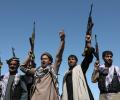
'But an overthrow of the Afghan government would really embolden regional militant groups in a big way.' 'LeT and JeM could be emboldened, and prompted to replicate in Kashmir what the Taliban did in Afghanistan.'

Many BJP leaders are of the view that most key members of the previous Cabinet could be retained.

'India has to prepare for future warfare where kinetic use of force at the border will be limited. War will take place in the realms beyond the border.'

'If an 'informal meeting' with Xi Jinping materialises before the SCO summit in June, that itself could be regarded as a significant breakthrough in India-China relations,' says Ambassador M K Bhadrakumar.

Imran Khan knows Pakistan is holding a strong hand and doesn't have to flaunt it while claiming victory. But Pakistan has learned from the experience of the 1990s -- high risk of going out on a limb, asserts Ambassador M K Bhadrakumar.

'Whatever comes in the minds of the Pakistani generals and Pakistan military, they just go for it.' 'They do not care about the consequences for their country or the consequences to the people of Pakistan.'

India and China met and spoke a lot this year, but failed to produce any meaningful results.
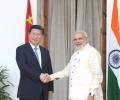
With the continuing stand-off in Ladakh casting a shadow over the Sino-India talks, Prime Minister Narendra Modi on Thursday raised 'serious concerns' over the repeated incidents along the border and sought an early settlement of the boundary question.

'Ensuring through diplomatic means and in conjunction with strategic partners that India will not be required to fight a simultaneous two-front war with China and Pakistan.' Brigadier Gurmeet Kanwal (retd) lists what India must have in its national security strategy.

Russia and the US began second round of negotiations on securing Syria's chemical arsenal, hoping the high-stakes talks would lead to broader peace efforts, even as Damascus submitted application to UN for joining the chemical weapons convention.

The meeting, which comes after the Doklam standoff, is aimed at a working a new paradigm for the bilateral relations for the next 15 years.
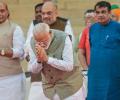
Modi, 68, was administered the oath of office and secrecy by President Ram Nath Kovind at a glittering ceremony at the forecourt of majestic Rashtraparti Bhavan.
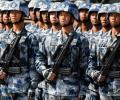
He called for delineation of the 3,488-km Line of Actual Control (LAC) which China has refused earlier.

'India stands to gain immensely by forging a developmental partnership with China.' 'While through sustained strategic communication there is scope to steadily expand the commonality of interests between the two countries.' 'This is also a practical way to ensure that differences do not get over-magnified and become disputes,' says Ambassador M K Bhadrakumar.

Modi was expected to arrive in Wuhan in the evening on April 26 and join Xi in the informal summit at a picturesque location the next day.
It seems China is ready to cooperate with India in the central Asian region through the SCO framework, the reasons for which are manifold, says Sana Hashmi.

'Clearly, the warming of ties can be a 'win-win' for India and China,' says Ambassador M K Bhadrakumar.

'This novel format of diplomacy -- the informal summit -- will not only facilitate bilateral communication and reduce miscalculations at the very top level of the two governments, but possibly open the space for China and India to speak in one voice on various issues of mutual concern,' note Feng Renjie and Ding Kun Lei
Pakistan National Security Advisor Sartaj Aziz brings to New Delhi a newfound Pakistani confidence, stemming from its leverage in Afghanistan, says Ajai Shukla

China's intended role for AIIB is not so different from the existing Western lenders like the World Bank.

'Afghanistan cannot be at peace until the Pashtuns regain their pre-eminent role in the country's governance,' says Ambassador M K Bhadrakumar.

'Will Muhammad Habib Zahir -- who was part of the team that arrested Kulbhushan Jadhav and went missing in Nepal -- figure in a Jadhav-for-Zahir deal?' asks Aditi Phadnis.

'From Doklam to Wuhan and the return of the India-China relationship to its previous equilibrium is indeed a major contribution of President Xi and PM Modi. Without any doubt they deserve the kudos for their sagacity and their wisdom,' says Ambassador Gautam Bambawale, India's envoy to China during the Wuhan summit.

The Taliban have the ISIS in its crosshairs. The Taliban has shown the skill to assimilate extremist elements if they are reconcilable as well as the ruthlessness to eliminate troublemakers, observes Ambassador M K Bhadrakumar

In a turnaround, Pakistan asked for "more evidence and information" from India on the Mumbai attack case and asserted that talks cannot take place without Kashmir being on the agenda, barely three days after the two countries agreed to re-engage.

The state-owned tabloid accused Silver of caving in to political pressure, saying the NBA was treating the Chinese market with arrogant disregard.
The NDB will have an initial authorised capital of $100 billion.
'There is a compulsion to look hard, decisive, and risk-taking; start something; and then conclude it in a way you can claim victory.' 'That is not such an easy option against China,' notes Shekhar Gupta.

The Wuhan meetings signify an incremental shift in China's position on India as well as each country buying time for the next phase of bilateral relations, says Srikanth Kondapalli.

Unless the Taliban goofs up in a big way, which seems highly unlikely, we are looking at a regime that will be around for quite a long while and present a level of governance that the puppets of the richest and most advanced countries failed to provide, predicts Ambassador M K Bhadrakumar.

'We should not have waited for the political crisis in Nepal to erupt before being galvanised into action,' says Shyam Saran. 'We should have seen what was coming and not accepted assurances from the leaders of the political parties at their face value.'
'It is advisable for Indian interlocutors to follow the Chinese tactic of repeating the Indian position, both for the record and to test the Chinese negotiator's resolve and intentions.' A riveting excerpt from former foreign secretary Vijay Gokhale's The Long Game: How the Chinese Negotiate With India.

The cascade of cordiality on both sides after the Modi-Sharif handshake in Paris was preceded by much planning and even goading from UK, US and Germany.

'While economic ties are making incremental progress, it is in the security and strategic domains that the India-Japan synergy is more compelling,' says Dr Rajaram Panda.

Brutal and ruthless, with terrible human rights records, these autocrats will welcome Narendra Modi to their realm this coming week.
'India needs to learn in Kashmir how to spread development.' 'Pakistan needs to learn in Balochistan how to spread development.' 'China needs to learn in Xinjiang and Tibet.' 'And if they can show tangible benefits, there will be less terrorism.' 'No one wakes up in the morning saying 'I want to kill myself', right?'

We must see New Delhi's position as a signal of competition to the Chinese grand design for the 21st century world, says Nitin Pai.

The two countries also asked all nations to stop cross-border movement of terrorists and asserted that a decisive collective response from the international community without 'double standards and selectivity' was required to combat the threat of terrorism.
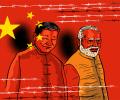
'An opportunity is at hand to think big and recast the India-China relationship on a new template, which would help the pursuit of our country's dream of major power status,' says Ambassador M K Bhadrakumar.
